DAY 29 OCTOBER
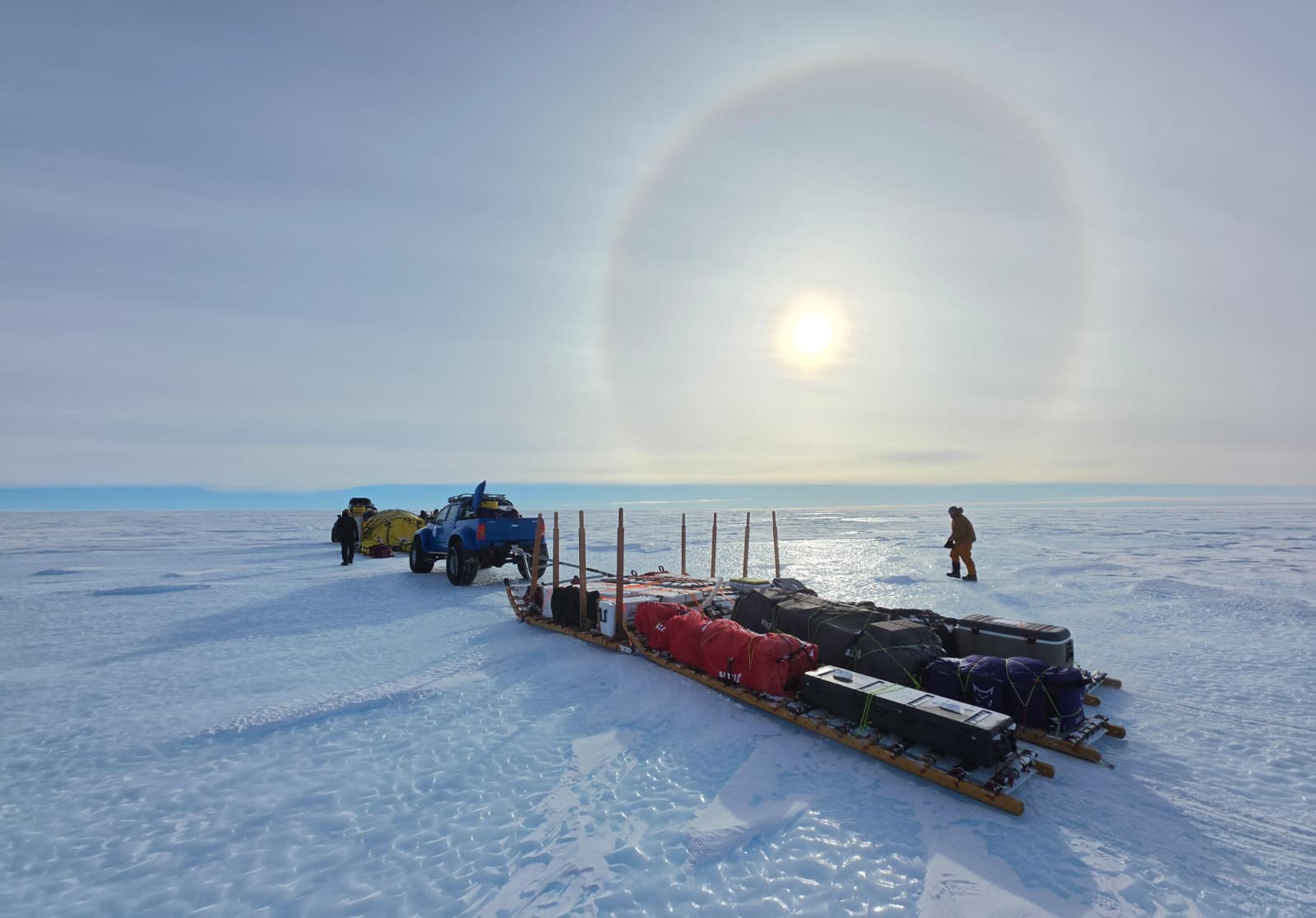
The tension that comes with the start of a new expedition is always there. Months of preparation, intense final weeks, and then, at the very last moment, unpredictable chance intervenes. We are in Antarctica, on this immense plain of hard ice. The cold is intense. Two motor vehicles from Novo Station have towed us to the convoy that will take us to our starting point. It was not the original plan, but it works. You have to adapt to events as they unfold.
Several days have passed since we left Spain. We arrived in Cape Town, South Africa, on the 19th. All the equipment we had shipped in the previous days was waiting for us there, stored in a hangar belonging to Ultima Antarctic Logistics, the company that brought us to this frozen continent, specifically to Queen Maud Land. We spent much of our time in the South African city checking every detail of our equipment, inspecting all the batteries and, above all, the scientific instruments we are carrying. We also had time to visit the Spanish Consulate—many thanks for the warm welcome. We made our final purchases as well, mainly food that might have deteriorated during its journey via Turkey before arriving there. As you can imagine, there is absolutely nothing in Antarctica. That is why it is uninhabitable. One example is enough: only two plant species live on the entire continent, and they are found thousands of kilometres from where we are heading, on the Antarctic Peninsula. All Antarctic wildlife is coastal as well.
Our plan had been to leave South Africa on Sunday for the Russian Novo Station. Once there, we would have around 36 hours to attach our Windsled to a motorised convoy heading inland. It would tow us up to the starting point of our expedition on the vast Antarctic Plateau. It was not much time, but it would have been enough.
Then everything changed. On Saturday we were informed that, due to poor weather conditions, our flight would not depart until Monday. That left us with very little time: only a few hours to assemble the vehicle, which had been waiting dismantled inside a container since the end of the previous traverse in February 2019. Finally, on Monday, we boarded the aircraft called Antarctica. Before boarding, we disinfected our boots in a special solution to avoid bringing any contaminants onto the continent. A few hours later, we landed on the blue-ice runway beside the Russian station. The runway is swept by powerful winds that expose ancient glacial ice, compressed over thousands of years and as hard as concrete, allowing even very large and heavy aircraft to land on conventional wheels instead of skis. The wind chill when we stepped off the aircraft was –18°C, so everyone changed into full polar clothing before landing.
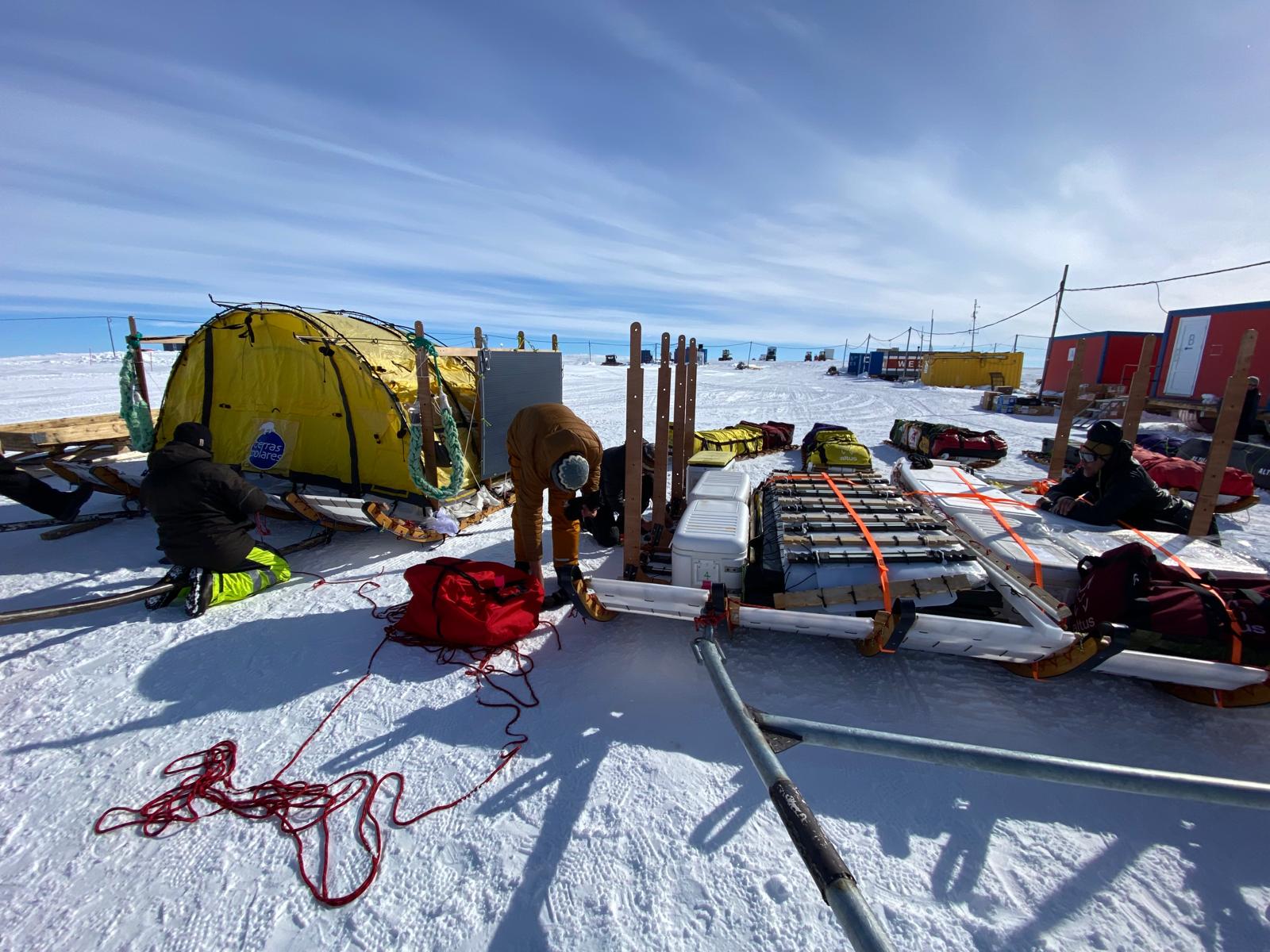
With so little time available, we got to work immediately. The best news was discovering that, more than six years later, every part of the Windsled was still in perfect condition inside its container. Another advantage of not using engines. Without a break, we began assembling runners and crossbeams. There are countless knots to tie, and every one of them must be made with great care because our safety depends on them. It has been a frantic effort. We worked continuously for 14 hours without stopping. There is a great deal of equipment to organise because the route ahead of us is long and demanding. Although we hoped the convoy would wait for us, it was not possible. It had a fixed departure schedule and left before we had finished assembling the Windsled.
Fortunately, once we had finished, we found another solution. Two Toyota vehicles, one of which accompanies the convoy, were available and were able to tow our vehicle, divided into two sections, to a rendezvous point with the convoy, which travels much more slowly while pulling its load with powerful tracked vehicles known as PistenBullys, used to groom snow and capable of hauling very heavy loads. Reaching them with the Toyotas turned out to be far more difficult than we had expected. In the end, after 14 uninterrupted hours, we climbed from Novo’s 650 metres above sea level towards the plateau across very difficult snow conditions. We are now at an altitude of 2,380 metres.
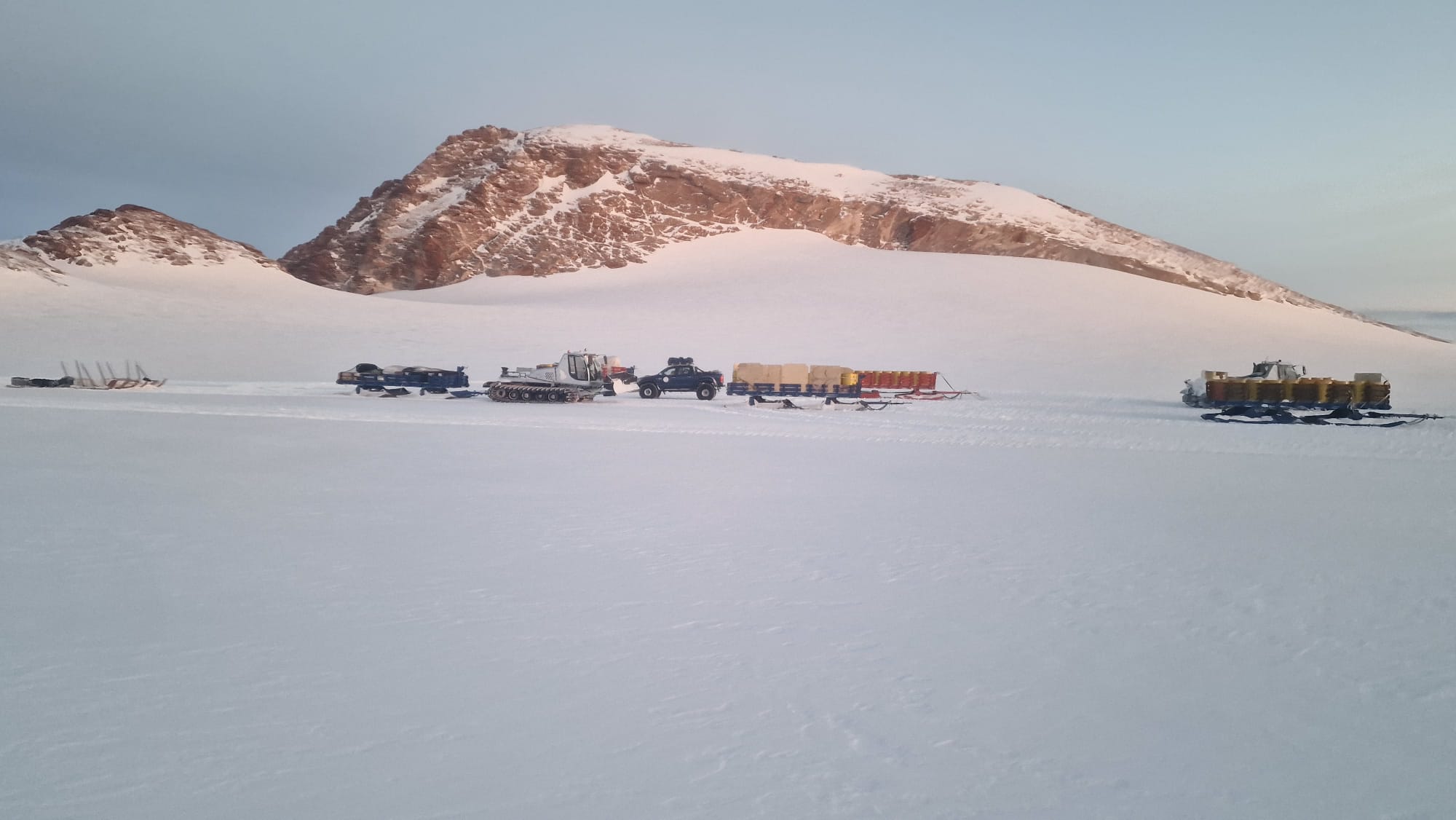
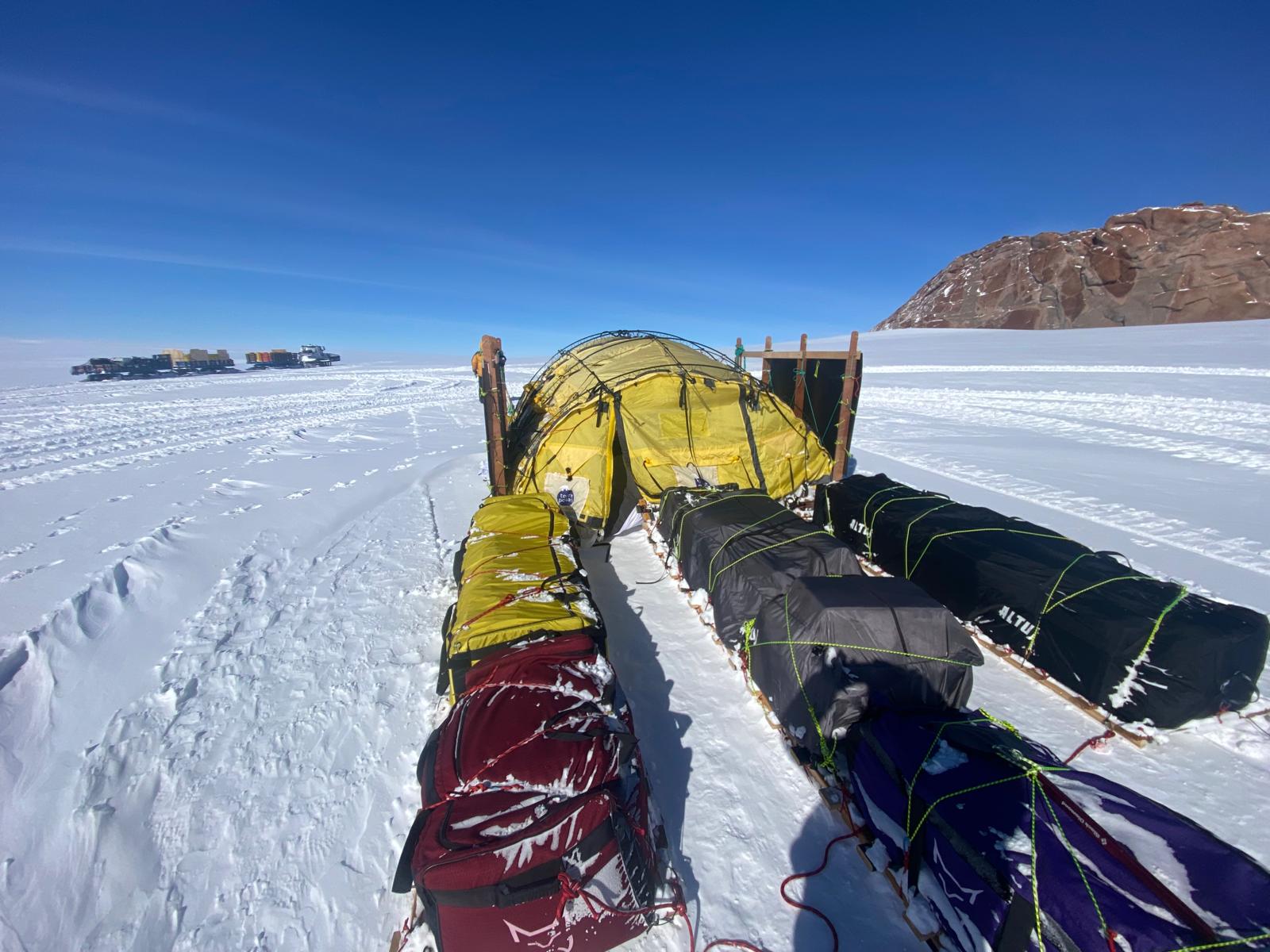
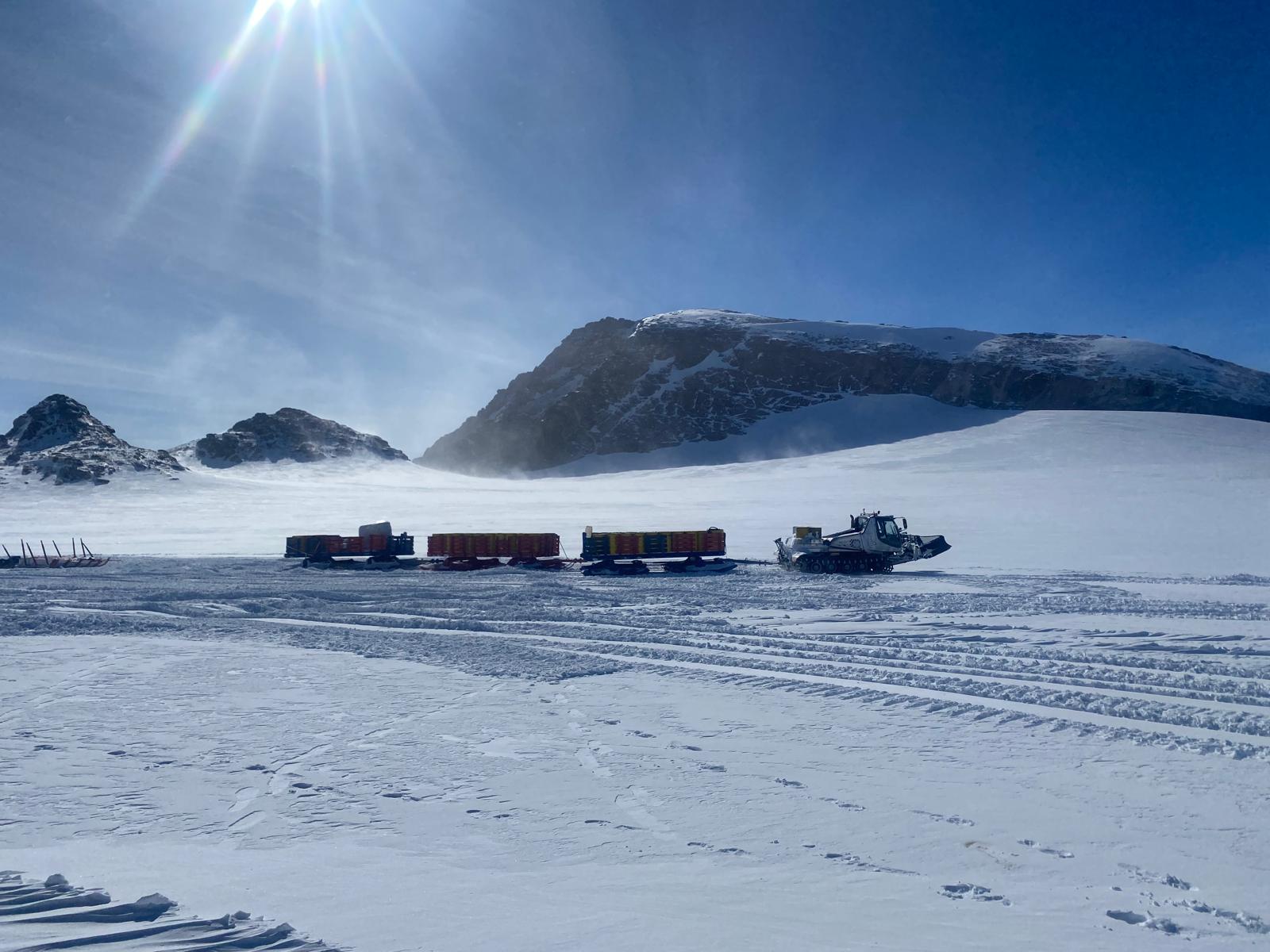
Just as fatigue was beginning to take its toll, we finally spotted the convoy in the distance. It is transporting supplies to an inland blue-ice runway used to support the logistics of nearby scientific stations. The convoy consists of two tracked vehicles towing cargo modules mounted on giant skis or sledges. By the time we reached them, we had been awake for more than 30 hours. The poor snow conditions in this area had made the first stage of the climb onto the plateau especially difficult. In the end, each tracked vehicle towed one section of the Windsled. In one section, with the living tent already assembled, the four of us are travelling together. Since joining the convoy, we have managed to cover only 20 kilometres in three stages before stopping for the night. The temperature is now –25°C, with a light wind of 15 km/h.
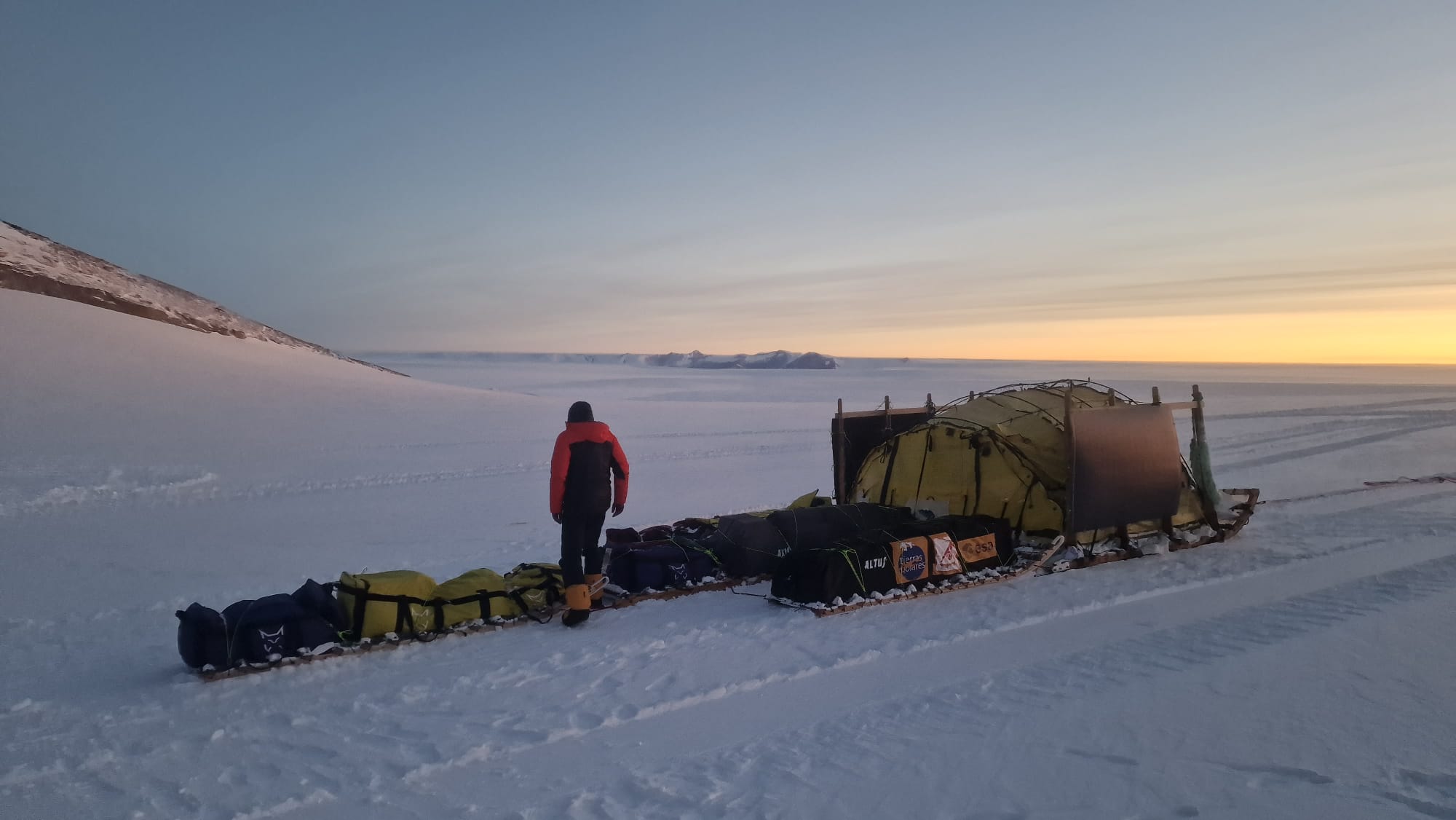
Now we have become part of a single convoy, moving at its slow but steady pace. One of the tracked vehicles pulls its own load while towing the section of the Windsled carrying our living tent; the second pulls the other section of the Windsled together with its cargo. A Toyota drives ahead to scout the route for safety. We all move forward together, in line. At this speed, we estimate it will take another two or three days to reach the point where our expedition will officially begin. From there, the convoy will continue in one direction and we will head in another, powered only by the wind through our traction kites.
We have a few days of relative rest ahead before we return to full activity. Before beginning our zero-emission Antarctic crossing, we will still need to complete the final preparation of the Windsled and all the scientific instruments on board before launching the kites. But this exciting scientific adventure has already begun.